

Home educated and/or self-studying, or teaching in mainstream education and wondering how GCSE subject grade distributions compare between Awarding Organisation (AO) specifications? Curious as to which AO subject specification is the market leader in term of entries entered?
If so, arc exams have produced this tabulation that might be of interest. It aggregates published AO provisional grades for selected ‘high volume’ GCSE subject examinations held in Summer 2025. 21 subjects in total, covering 77 specifications offered by AQA, Pearson Edexcel, OCR and Eduqas. As well as detailing cumulative grade distributions for each specification, it also shows candidate entry volumes and market leading specifications (emboldened).
AQA dominate most core subjects (English Language, English Literature, Biology, Chemistry, Physics and Combined Science), where they typically command circa 80% market share. They also account for three-quarters of all French, German and Spanish entries.
Pearson Edexcel continues to lead in Mathematics, with 62.5% of Summer 2025 entries, though this is down 1.3 percentage points from last year. AQA also saw a drop of 1.8 points, while Eduqas gained market share, increasing by 3 points.
GCSE Computer Science, a relative newcomer first launched a decade ago replacing GCSE ICT, recorded just over 90,000 entries this Summer, down 6,400 on the previous year. OCR remains the market leader accounting for 74% of all entrants.
As with A Levels, reported in our previous blog, there are some stark differences between AO subject grade distributions. Across the subjects shown, there is a spread of between 1.4 and 47.1 percentage points between the specification with the highest >= Grade 4 attainment versus that with the lowest.
For example, 68.4% of candidates sitting OCRs spec J351 (English Language) achieved a Grade 4 or above compared to only 21.3% achieving equivalent grade attainment for Pearson Edexcel’s English Language 2.0 specification (1EN2) which, coincidentally, recorded a 38.7% increase in entries on the previous year (66,425 v 47,904).
Similarly, 61.7% of students who sat Pearson Edexcel’s Mathematics specification (1MA1, three papers) achieved a Grade 4 or above, compared to just 18.1% for Eduqas’ two-paper Mathematics specification (C300). However, caution is needed when interpreting these results, as awarding organisations do not separate data for ‘Higher’ and ‘Foundation’ tier entries. This makes it impossible to know the proportion of each tier and how it affects grade outcomes — for example, the highest grade available on the Foundation tier is Grade 5.
Naturally, comparing subject grades across awarding organisations is just one piece of the puzzle when choosing a specification. Other important factors include exam entry fees (more on that in an upcoming blog), market share, and the content and familiarity of the specification itself. Still, we hope the data shared here offers some food for thought and provides useful insight into current GCSE subject trends.
Of the 21 subjects shown, AQA are market leaders in 13, Pearson Edexcel in 5, OCR in 2 and Eduqas in 1. This is reflected in overall Summer 2025 GCSE market share, all subjects, as illustrated below.
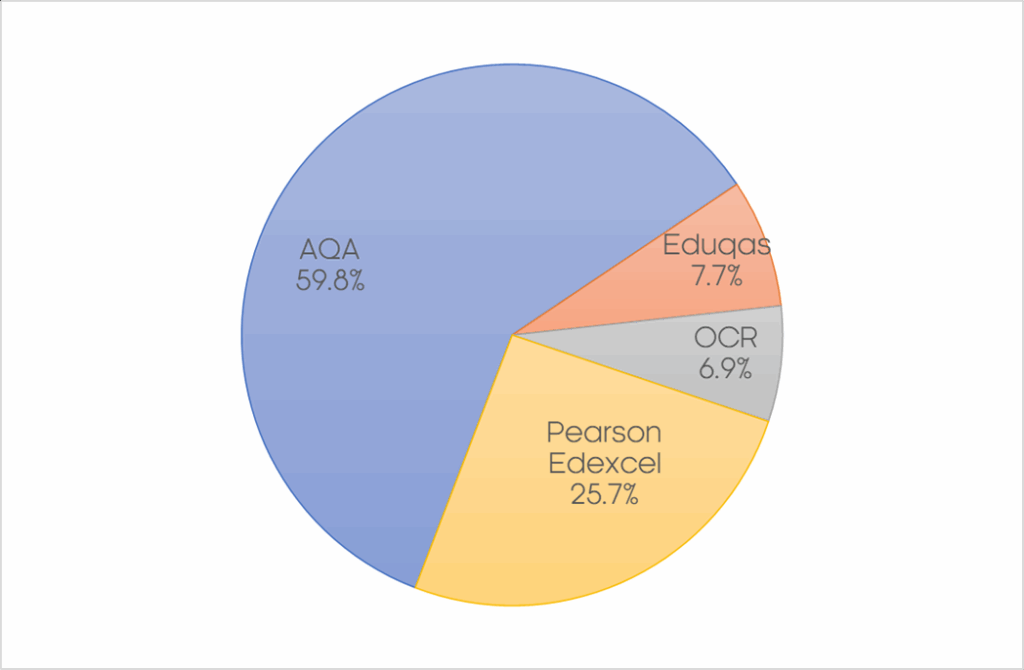
AO market share this Summer almost mirrors that of Summer 2020. However, for the first time since then, AQA’s overall GCSE market share has dipped below 60%. Over the same period OCR and Pearson Edexcel’s share has declined 0.3% and 0.1%, respectively, whilst Eduqas has recorded a 0.8% increase, replacing OCR as the third most popular AO.